Enterprise-Grade ERP Integration for B2B Ecommerce
Real-time, configurable, multi-ERP connectivity that powers accurate pricing, inventory, and order workflows — without brittle middleware.
Why ERP Integration Matters
High-performing B2B ecommerce does not operate in a vacuum. The most critical questions your customers ask — What can I buy? What is my price? Is it in stock? When does it ship? — all trace back to one source of truth: your ERP. Without reliable ERP integration, ecommerce platforms deliver incomplete answers. Pricing falls out of sync. Inventory data lags. Orders get routed incorrectly. Customer-specific contracts get ignored. The result is a storefront that undermines the very operations it was meant to support. When your ecommerce platform connects deeply and in real time with your ERP system, the business impact is immediate:

Accurate Pricing & Contract Terms

Real-time Inventory Visibility

Consistent Order & Quote Workflows

Faster Onboarding of Acquisitions

Better Customer Experience with Fewer Errors
Built for Deep Native ERP Integration
Most B2B ecommerce platforms treat ERP integration as an afterthought, relying on generic middleware tools like Boomi or Jitterbit to bridge the gap. These iPaaS solutions introduce additional vendor dependencies, transaction-based cost structures that scale poorly, synchronization delays that break real-time workflows, and a critical lack of support for ERP-specific business logic. ROC Commerce was architected differently. Its ERP connectivity is native, direct, and purpose-built for the complex operational realities of B2B distribution and manufacturing — including multi-company structures, customer-specific pricing engines, credit limit enforcement, unit-of-measure conversions, and configurable order workflows that no generic middleware can replicate. The difference matters in practice: where iPaaS tools map fields, ROC Commerce understands and executes ERP logic. This level of ERP-driven accuracy is not a differentiator — it is a baseline requirement.
Key Capabilities

Purpose-Built for Enterprise ERP Complexity
ROC Commerce uses a standardized, modular connector architecture that supports leading enterprise resource planning systems — including Infor CSD, SX.e, Epicor P21, and Microsoft Dynamics 365 — simultaneously and without compromise. There is no brittle middleware sitting between your storefront and your ERP. Each connector is designed to handle the full scope of ERP-specific complexity: multiple business units, distributed ERP instances, custom fields, platform customizations, and intricate operational data structures that generic integration layers simply cannot map accurately. For enterprises operating multiple brands or recently integrating acquired businesses, this modular approach means each entity can run on its own ERP system while sharing a single ROC Commerce deployment.

Real-Time, Stateful ERP Connectivity
Most ecommerce platforms rely on stateless REST calls that query ERP data in isolation. ROC Commerce's ERP integration maintains persistent ERP sessions that mirror real human interaction with the underlying system — enabling workflows that stateless approaches cannot support. This means ERP data — customers, ship-to addresses, live pricing, open quotes, inventory levels — surfaces directly in the web interface, dynamically and accurately, for every user session. Every field, filter, display order, and visibility rule is fully configurable through the admin UI, with no developer involvement required for day-to-day adjustments. The result is a buyer experience that reflects the same data your internal team sees inside the ERP itself.

Multi-ERP and Multi-Brand Deployment Support
A single ROC Commerce instance can support multiple ERP connectors operating in parallel. Unified APIs enforce consistent business rules across brands, ensuring that pricing logic, order validation, and customer-specific workflows behave correctly regardless of which ERP system sits behind each business unit. For enterprise organizations managing distributed operations, this architecture eliminates the need for redundant platforms or custom integration work each time a new brand or location is brought online.

Supported ERP Systems
ROC Commerce delivers native B2B ecommerce ERP integration for the following platforms: Acumatica, Business Edge, CDK Interdealer, Infor, EnMark Eniteo, Epicor, JD Edwards, Karmark Fusion, Microsoft Dynamics 365, Odoo, Oracle NetSuite, Sage, SAP, and Totvs, with more being added quarterly.
Don't see your ERP? ROC Commerce can connect to any ERP or API through the ROC Integration Hub— the same enterprise-grade framework used by native connectors. For systems without available APIs, ROC also supports file-based transfer and in-product upload methods, so no integration path is off the table.
How ROC Commerce ERP Integration Hub Works
ROC Commerce's ERP Helper framework goes beyond standard data synchronization. It handles the full spectrum of ERP-driven workflows — from basic customer lookups to complex, multi-step transactional processes — with a level of configurability and fidelity that sets it apart from conventional integration approaches.

Organization Data Synchronization
ROC Commerce synchronizes the complete organizational data profile from your ERP: customer records, billing information, ship-to addresses, credit limits, and tax groups. Job pricing contracts, unit-of-measure logic, and ship-to rules are all pulled directly from the ERP, ensuring that every buyer sees data that accurately reflects their account setup — not a cached approximation of it.

Customer & Account Support
The storefront surfaces real-time access to orders, order status and history, quotes and quote status, invoices, ship-to addresses, customer profiles, account management, customer part numbers, order lists and more. These integrations also support key self-service capabilities such as reordering, quote-to-order conversion, filtering, pagination, sorting, and field-level visibility controls. Business teams can configure exactly what each user role sees and how data is presented, without writing a single line of code.

Interactive ERP UI Integrations
This capability is unique to ROC Commerce. Rather than simply pulling static data from the ERP, the Interactive ERP UI integration emulates real ERP workflows directly inside the web interface — including quote-to-order conversions, step-by-step navigation with built-in validations, and binary document generation such as PDF invoice and quote output. These are workflows that traditional stateless REST integrations fundamentally cannot replicate.

Pricing
ROC Commerce retrieves and enables every level of customer specific pricing, including organization, job, contract, ship to, strategic, custom pricing plus nearly any other ERP or 3rd party pricing capabilities used by a client. ROC Commerce also enables a hybrid approach where some pricing logic or tiers like retail pricing or some tier pricing is in ROC and the rest is in the ERP.

Unit of Measure
ROC Commerce makes "Unit of Measure" a strategic opportunity by providing the ability to do real-time Unit of Measure calls enabling unique unit packaging, bundles, sell packs, etc. to support regular purchasing, punchout, VMI, and invoice alignment with your customers. This further enables pricing filters to respect the exact contract terms established for each account — eliminating the discrepancies that arise when pricing logic is duplicated outside the ERP.

Cached Authentication
OAuth token caching maintains authenticated ERP sessions efficiently across user interactions, reducing system load while preserving the performance and security standards required for enterprise-scale deployments.
Architecture Built for Scale
ROC Commerce's Integration Hub is engineered for long-term performance and scalability, maintainability, and extensibility across complex enterprise environments.

API-First Design

Extensible Data Models

RabbitMQ + MassTransit Queuing

CoreProtect Architecture

Circuit Breaker Protect

Developer-Centric Tooling with No-Code Configuration
From Connected Systems to Real Business Impact
Out-of-the-Box Integrations
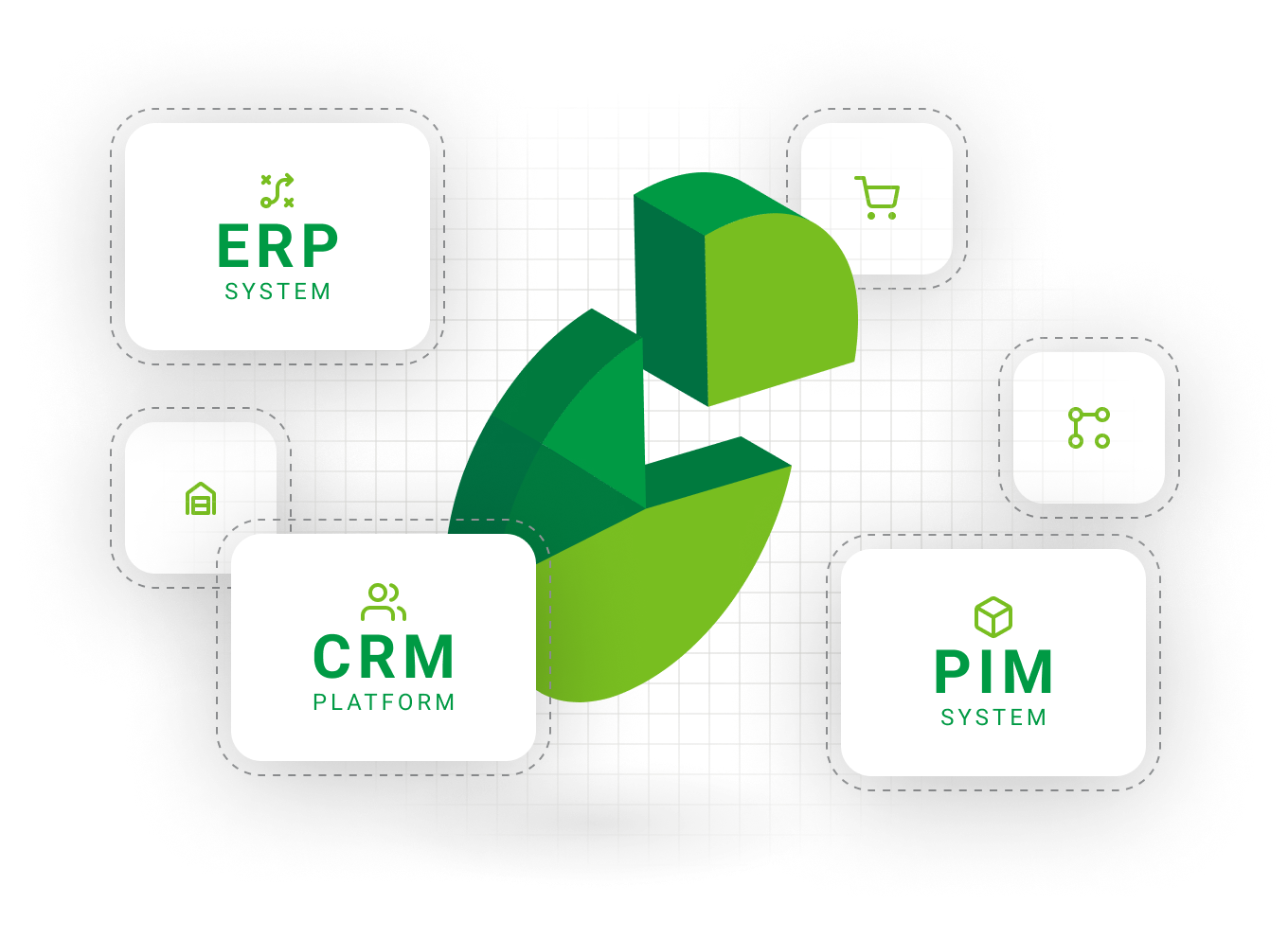
ERP integration is the backbone of a connected commerce operation, but it does not stand alone. ROC Commerce delivers pre-configured integrations across the full technology stack that B2B businesses rely on:
- Shipping and fulfillment
- CRM and marketing automation
- Product data and PIM
- Payments
- Punchout
- Accounting and tax
- Returns and warranty
Every one of these integrations operates in cohesion with your ERP data layer, ensuring that pricing, inventory, order status, and customer records remain consistent across every system in your stack.
Start Your Integration Today
The operational impact of replacing fragile middleware with native ERP integration is measurable. Organizations running ROC Commerce's ERP-integrated platform have reported:
- 40% reduction in manual workflows through automated order routing, fulfillment, and shipping update processes
- 30% reduction in inventory carrying costs through AI-driven stock level optimization and real-time ERP data analysis
- 98% product availability maintained through accurate, ERP-synchronized inventory management
- 25% increase in average order value driven by ERP-informed, personalized product recommendations
These are not theoretical benchmarks. They reflect what happens when your ecommerce platform stops working around your ERP and starts working directly with it.
See How Leading B2B Organizations Run on ROC Commerce
From electrical distributors to industrial manufacturers, hundreds of B2B businesses rely on ROC Commerce to power ERP-connected ecommerce operations at scale.

Ready to Connect Your ERP to a Platform Built for It?
Stop working around your ERP. ROC Commerce delivers real-time, configurable, enterprise resource planning integration that reflects your actual business logic — not a simplified version of it.
ERP Integration FAQs
-
ROC Commerce integrates with ERPs, CRMs, marketing automation platforms, PIMs, shipping and fulfillment systems, payment gateways, accounting and tax platforms, and more. For systems not natively supported, the ROC Integration Extender uses the same enterprise-grade framework to connect with any ERP or API. Where no API is available, file-based transfer and in-product upload are also supported.
-
ROC Commerce maintains real-time ERP sessions, unified APIs, ERP-grade validation, and complete transactional control. Pricing, inventory, order status, and customer account data are retrieved directly from the ERP — not from a replicated or cached data layer that risks falling out of sync.
-
ROC Commerce uses OAuth token authentication, secure session caching, and an isolated single-tenant architecture to protect data integrity and access control. Encryption protocols including TLS/SSL are applied across all integrations, and the platform meets strict security standards including PCI DSS compliance for payment workflows.
-
Yes. ROC Commerce is purpose-built for multi-ERP and multi-brand environments. Its pluggable connector architecture and unified API framework allow a single platform instance to run multiple ERP connectors in parallel, each enforcing its own business logic while sharing a consistent front-end experience.
-
Yes. ROC Commerce's Interactive ERP UI integration emulates screen-based ERP logic — including pop-ups, step-by-step validations, quote-to-order conversions, and multi-step workflows — directly inside the web interface. This level of workflow fidelity is not achievable through standard stateless REST integrations or generic iPaaS middleware.
-
No ERP system is out of reach. The ROC Integration Extender extends the same modular connector framework to any ERP or API not natively supported. For legacy systems without available APIs, ROC Commerce also supports file-based and in-product upload integration methods.
-
ROC Commerce significantly reduces integration timelines by eliminating middleware overhead and offering preconfigured modules for widely used ERP platforms including Infor, Epicor P21, and Microsoft Dynamics 365. Integration debt is minimized from day one, and business teams can begin configuring ERP-driven workflows without waiting on custom development cycles.